
 Follow a
  See our
  View our
 Download the

IMPACT AREA 1
Policy, governance and institutional change
Nature-based solutions are gaining traction in national policy; however, many local governments across Africa still face significant barriers to implementing them. While cities are responsible for critical decisions regarding land use, infrastructure and service delivery, they often lack the mandates, resources, and institutional capacity and coordination needed to integrate nature into their governance systems and across sectors and levels of government. Strengthening local governance – through policy reform, institutional capacity and cross-sector collaboration – is essential to create the conditions that allow NbS to deliver their full benefit where they are needed most: in cities and communities.
The UNA project worked directly with local practitioners, communities and government stakeholders to improve the governance systems shaping urban development. Through targeted support for policy reform, mandate alignment and institutional coordination, the project helped cities address disconnections between departments, sectors, and levels of government, mainstream nature into decision-making and policy reform and better link local actions with national and global agendas. By investing in governance that centres both people and ecosystems, the UNA project helped lay the foundation for more inclusive, climate-resilient urban futures.
1a
Influencing policy reform and aligning mandates
As cities face the urgent task of rethinking urban development to centre both people and nature, the UNA project helped them reassess current policies, reform systems and clarify institutional mandates. This approach elevated nature from a peripheral consideration to a central pillar of urban governance. As a result, cities were able to integrate sustainability and nature considerations into planning and decision-making, foster alignment across departments and enable coordinated, cross-sectoral action.
Case study
Dar es Salaam: Embedding nature into urban policy
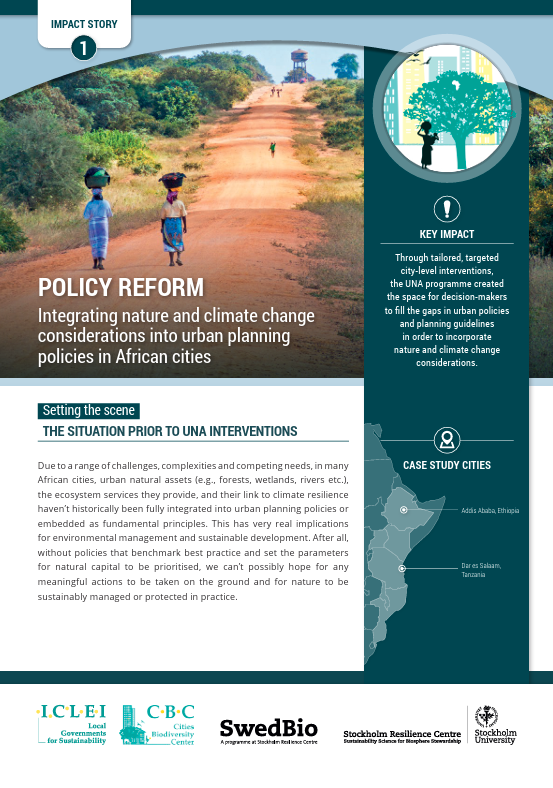
Through the UNA Rivers for Life project, officials in Dar es Salaam took part in hands-on workshops and multi-level dialogues that highlighted how NbS can improve climate resilience, water security and public health. This process revealed key gaps in Tanzania’s 2007 Urban Planning Guidelines, which largely overlooked nature and climate concerns. With support from the UNA project and local partners, the City co-developed clear, actionable recommendations to update the guidelines. These were formally submitted to the national Ministry of Lands, Housing and Human Settlements Developments, which committed to implement them. Since then, Dar es Salaam began allocating budget and planning resources to protect natural assets, and city officials report a renewed understanding of nature’s multi-sectoral benefits. Through subsequent work alongside ICLEI, they developed a Thematic Atlas – a digital tool that links spatial data of urban challenges with natural features and their ecosystem services. This tool helps city officials strategically invest in green infrastructure. The City has also dedicated resources to strengthen development control and improve land use planning at a national level.
Learn more about how the UNA project helped unlock policy reform in African cities:

UNA and ICLEI has helped us to prepare a city biodiversity action plan. We have been using that biodiversity action plan to reestablish tree nature and also… to improve the management of the environment of Dar Es Salaam greening activities. We are making the environment green.
We make it better for people to live, because the trees reduce the winds and also the health problems which we’re facing, especially in cities.
–
Amani Kavishe, Principal Wildlife Officer, Dar es Salaam
1b
Linking local action to international agendas
By aligning city-level action with national priorities and global frameworks such as the Sustainable Development Goals (SDGs) and the Kunming-Montreal Global Biodiversity Framework under the Convention on Biological Diversity, the UNA project helped bring global sustainability agendas closer to the realities of African cities. This localisation helped cities translate global commitments into practical, place-based solutions that reflect local contexts and priorities.
Case study
Entebbe: Linking local action to national and global goals
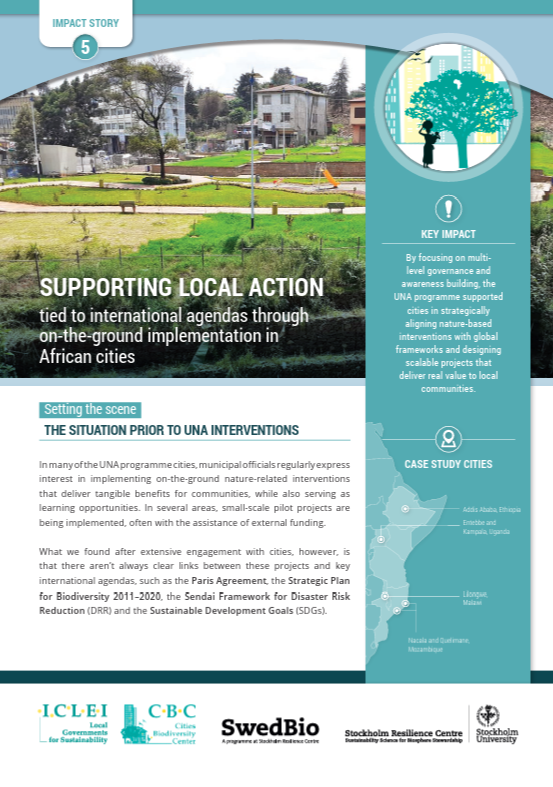
The UNA project’s work in Entebbe, Uganda began with national–local dialogues that brought government stakeholders together to co-design interventions with strategic impact. National officials emphasised the need for scalable projects, which led to plans for a social-ecological buffer zone around the Namiiro wetland, including the planting of 400 native fruit trees. When flooding and the COVID-19 pandemic disrupted this plan, the UNA project and city actors adapted by shifting focus to community resilience. Using NbS, the project built skills in permaculture, water harvesting and sustainable resource use, and developed a mobile app, THRIVE, to support this learning. This locally grounded work directly contributed to Uganda’s commitments under the SDGs and Sendai Framework. It also strengthened coordination between different levels of government, advancing a whole-of-government approach to urban planning and decision-making.
Learn more about how the UNA project connects local actions to national and international agenda:
Pathway resources
Policy, governance and institutional change
Impact story 1: Policy reform
Impact story 5: Local action and global agendas
Case study: Working with nature to reduce disaster risk in Africa
Video: Waste is wealth
Video: Minecraft in Addis