 Follow a
  See our
  View our
 Download the
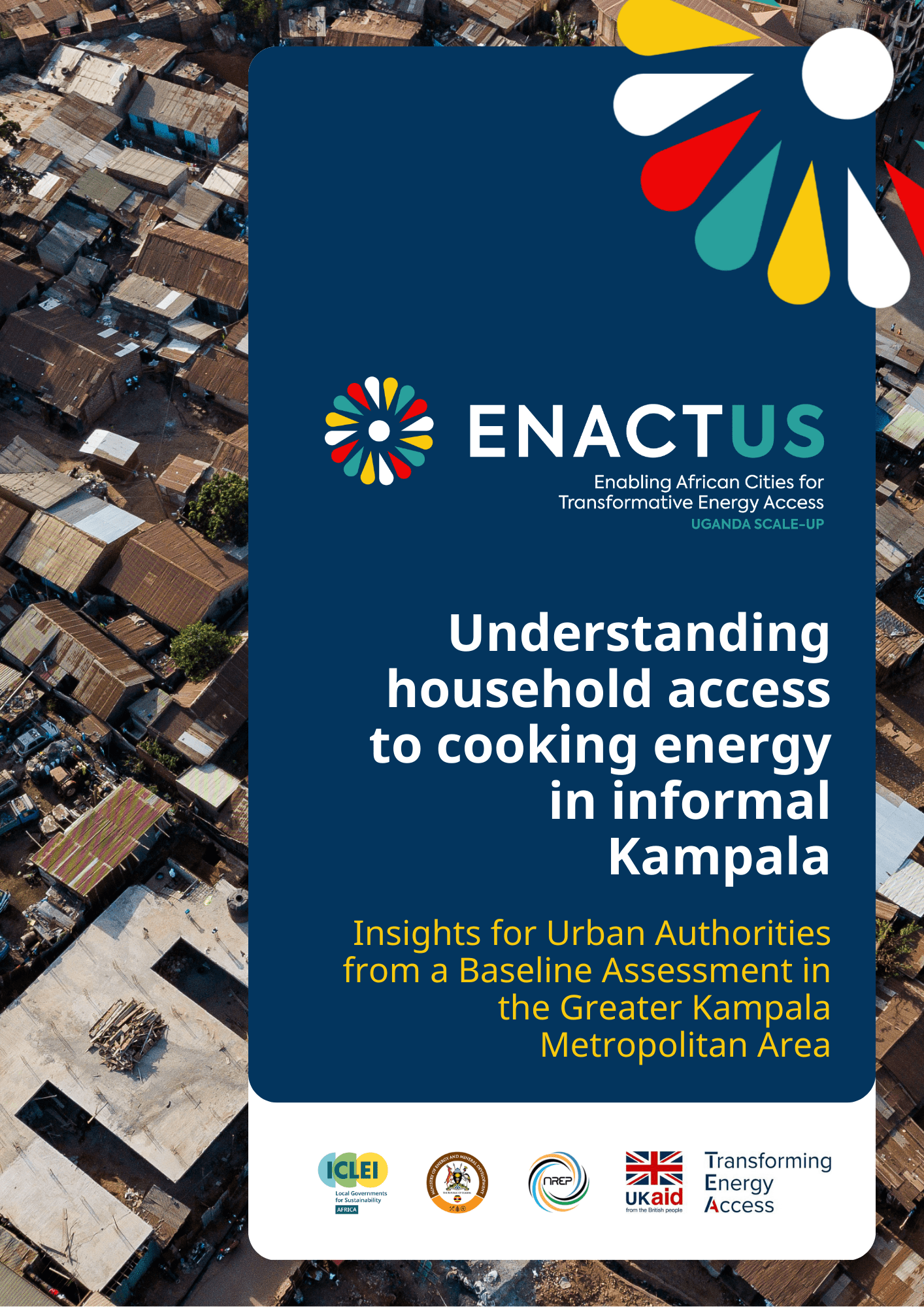
Understanding household access to cooking energy in informal Kampala



Download:
Related ICLEI Pathway(s)
About
Resource summary
Insights for Urban Authorities from a Baseline Assessment in the Greater Kampala Metropolitan Area. What is the baseline situation?
This baseline survey provides a snapshot of household cooking energy access in four informal settlements within the Greater Kampala Metropolitan Area (GKMA): Banda, Kirinya, Nankulabye, and Nansana East. Conducted jointly by ICLEI Africa and ACTogether Uganda in support of the Ministry of Energy and Mineral Development (MEMD)’s Clean Cooking Unit and local governments, the study covered 1,110 households to understand patterns of energy use, housing, income, and cooking behaviour.
Findings reveal that these settlements are densely populated, low-income communities, with an average household size of 4.4 people. The majority of respondents are female (82%), reflecting women’s central role in household energy decisions. 67% of households are tenants, underscoring the transient, rental-dominated nature of informal urban life. While electricity access is relatively high, cooking remains almost entirely dependent on biomass fuels— charcoal and firewood—used by over 90% of households. Fewer than 10% use LPG or electric appliances as their main cooking source, though small but growing numbers of households now combine modern and traditional technologies in fuel-stacking arrangements.
Related resources
RISE Africa report 2025
Navigating the regulatory landscape for early-stage embedded generation projects
Financing and ownership models for municipal embedded generation
RISE Africa report 2025
Navigating the regulatory landscape for early-stage embedded generation projects