
 Follow a
  See our
  View our
 Download the



Millions are invested in sustainability programmes. Communities participate. Activities happen. But when it’s time to report back, the hardest question isn’t “What did you do?” It’s “What actually changed, and how did your work contribute to it?”
Impact storytelling answers that question. It bridges the gap between monitoring data and meaningful narrative, translating technical evidence into clear, credible stories about change: what shifted, for whom, why it matters, how the programme contributed, and what comes next. It demonstrates that programmes are not only busy, but effective – learning, adapting and delivering outcomes that matter to people.
When done collaboratively across sectors, disciplines and scales, impact storytelling becomes an act of narrative justice. It values the knowledge embedded in local practice and cultures, giving credit to the people and partnerships that actually drive transformation.
ICLEI Africa is supporting the International Development Research Centre (IDRC) to tell the impact story of its Step Change Programme. Working with the project teams to strengthen their skills in the methodologies, we are using outcomes harvesting and collaborative sensemaking to identify and communicate – through narrative and visual impact stories – the programme’s most significant shifts, insights and contributions.
What impact storytelling is (and isn't)
Impact storytelling is not a string of feel-good anecdotes or glossy case studies detached from evidence. It is the disciplined practice of surfacing real changes – behaviours, relationships, policies, practices, or resource flows – then creating a credible story that connects those changes to an initiative’s contribution. It makes use of an outcomes harvesting methodology that informs collaborative narrative framing. When implemented effectively, it:
- Focuses on outcomes, not just activities or outputs
- Shows contribution, not unduly claiming causation
- Makes learning visible, including what didn’t work and what was adapted
- Centres people and context, not just indicators
The result is a story of change that stakeholders can trust and act upon.
The value of outcomes harvesting-driven storytelling
Contextualisation is the foundation of credible impact. Stories ground our understanding of impact in place. In ecosystem-based adaptation or inclusive finance, context determines meaning: the same intervention will look different in a floodplain in Uganda, a township in South Africa, or a dryland ecosystem in Senegal. Impact storytelling makes visible the web of social, ecological and governance relationships that shape whether interventions succeed. Quantitative data alone cannot convey how shifting rainfall, customary land rights or women’s collective agency intersect to produce specific outcomes.
Personal stories illuminate systemic shifts. Individuals embody the systems they inhabit; their stories reveal how institutional and cultural barriers are shifting. A woman entrepreneur accessing a climate micro-grant tells us about the inclusivity of finance systems. A community leader integrating ecosystem restoration into local bylaws signals institutional mainstreaming of nature-based solutions. When analysed collectively, such stories map the architecture of transformation, showing how change feels and where it is taking hold.
Storytelling builds legitimacy, connection and mobilisation. Beyond evidence, storytelling generates belief and participation. In cities and communities facing socio-economic and climate vulnerabilities, legitimacy is built through meaningful connections, not just data. Stories of change shared between peers, governments and funders foster empathy and trust. They inspire replication, funding and political will. Harvesting and communicating outcomes helps actors see themselves as part of a larger transformation. Stories become engines for movement-building and collective action.
Ethical storytelling transforms accountability. When integrated with participatory outcomes harvesting, impact storytelling reframes accountability. It demands that we, as knowledge brokers and change agents, listen carefully, contextualise evidence collaboratively, and ensure that those who contribute to change are credited for it. Storytelling becomes both a monitoring tool and a moral practice, one that recognises transformation as a collective, relational process.
What outcomes harvesting delivers
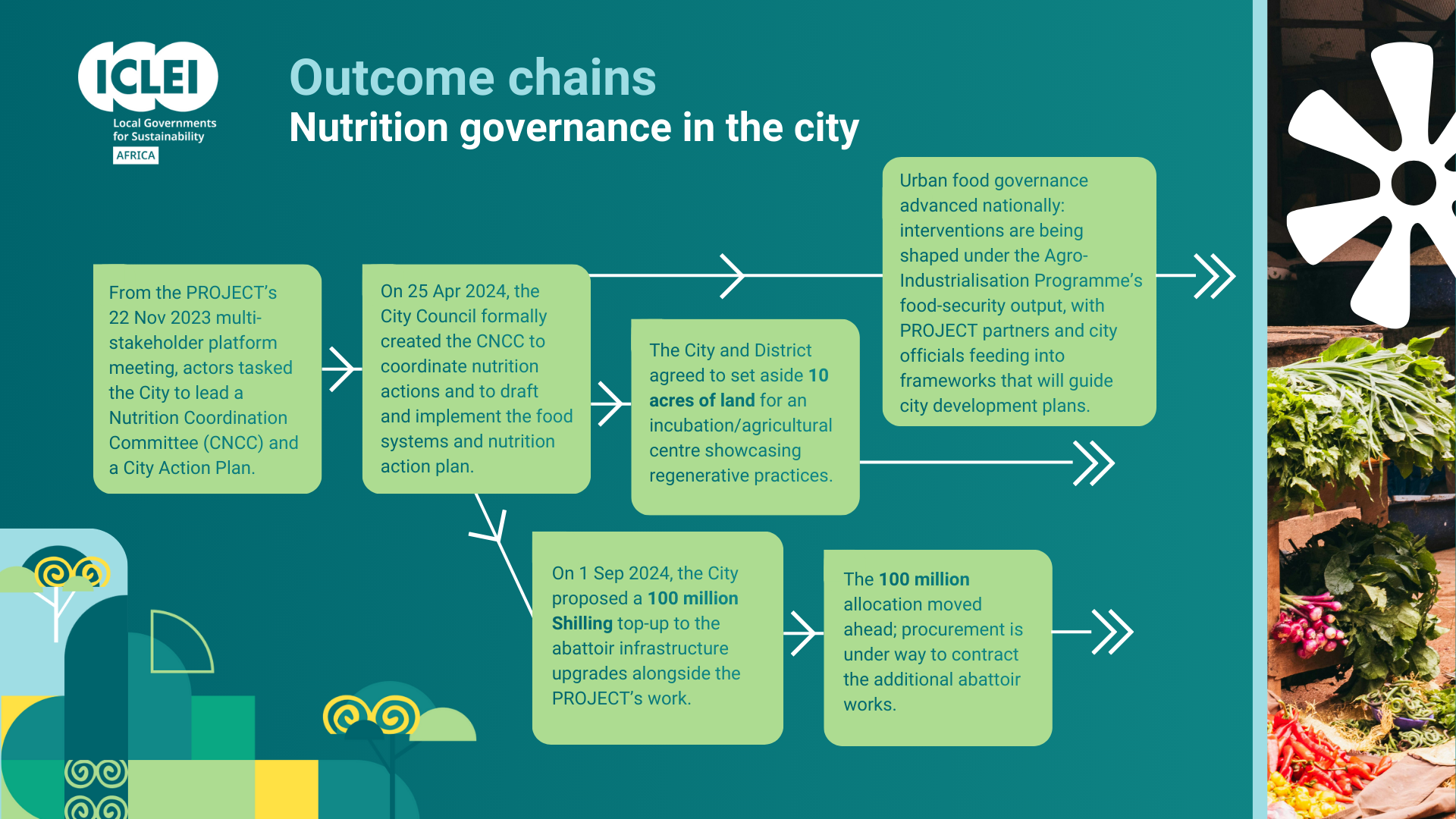
Traditional monitoring frameworks tend to track outputs, like workshops held, individuals trained, funds disbursed and hectares restored, but may miss the subtle shifts that signal real transformation. Outcomes harvesting complements these frameworks. The harvested outcomes become the pieces in an outcome chain, making visible how specific outcomes lead to further results, and how project contributions build upon and reinforce each other.
Outcomes harvesting traces pathways of influence – both planned and unexpected – starting by documenting what’s changed, and working backwards to see how a project influenced these outcomes. Change is ‘actor centred,’ seeking shifts at institutional or individual levels. This approach seeks contribution, not causation, making explicit that we as project implementers are not the sole drivers of complex change.
A real-world example of an outcome chain from one of ICLEI Africa’s projects (with specific details removed), is visualised below. It shows the progression of change from discussions of stakeholder priorities around food and nutrition security at city-level, to both implementation of built infrastructure and recognition of city insights at national level. It draws clear linkages between dialogue and specific actions.
What outcomes harvesting demands
While outcomes harvesting offers rich, human-centred insights that numbers alone can’t deliver, it comes with its own demands and trade-offs when telling credible impact stories.
The attribution question remains. Sustainability outcomes still emerge from many actors and shifting contexts. Outcomes harvesting asks us to show plausible contribution rather than definitive causation, which is more realistic but also requires careful evidence and clear communication. Stories need a throughline, but they must acknowledge the collaborative nature of change.
Evidence takes work. Because harvesting often happens retrospectively, teams must piece together documentation from multiple sources: project records, stakeholder interviews, observable changes in practice or policy. This triangulation protects credibility but adds time and cost. We argue that the richness of insight, learning potential, and nuance of evidence is absolutely worth the time investment.
Inclusion requires intention. There’s a risk of gravitating toward the most compelling stories, the most articulate voices or the clearest ‘wins’. Power dynamics can mute marginalised perspectives. Gender equality and social inclusion don’t happen by accident in outcomes harvesting; they require deliberate effort to seek out diverse experiences and create safe spaces for honest reflection, including about negative outcomes, and what hasn’t worked.
Synthesis is an art. Each outcome is deeply context-specific. Aggregating stories across geographies, sectors or timeframes can flatten the texture that makes them meaningful. Yet funders and policymakers often need portfolio-level insights. The challenge is synthesising patterns without erasing nuance, and aligning with donor frameworks without losing local meaning.
These tensions are inherent to the work of capturing complex change. Outcomes harvesting doesn’t resolve them so much as make them visible and manageable. It is one tool of many that ICLEI Africa uses, which can provide useful insights, whether it is undertaken to provide evidence of the impact of emergent and flexible projects, or used to complement rigid quantitative reporting.
Why the effort matters
When undertaken thoughtfully, impact storytelling grounded in methodologies like outcomes harvesting does more than satisfy reporting requirements. It changes how programmes understand and communicate their work. It reveals how change actually happens in complex settings, giving leaders and funders the insight and confidence to invest where it matters most. It demonstrates that a programme is not simply delivering activities but learning, adapting with purpose, and deepening its impact over time.
Perhaps most importantly, it ensures that the people who drive transformation are seen, heard and credited, and provides evidence that the resources invested have led to both planned and unexpected impact. In an era in which sustainability challenges grow more urgent and funding faces greater scrutiny, this kind of evidence matters.
That’s why impact storytelling matters. It turns evidence into narrative that resonates, understanding into decisions that stick, and monitoring into momentum for lasting change.