Bringing African priorities and perspectives to COP30
As the world approaches COP30, marking a decade since the landmark Paris Agreement, global climate action remains far off track, with the world facing an overshoot of 1,5’C temperature rise, with dire consequences for the world’s oldest continent. This moment demands honest reflection and renewed commitment.If we fix implementation, ambition will come. The Brazil COP Presidency has signalled a “COP of truth”, calling for transparent, solutions-driven dialogue. We must take a frank look at the future we are creating if we continue on the current development trajectory. ICLEI Africa brings the voices and experiences of African cities to these conversations, ensuring that African leadership continues to shape global climate action and inspire a step change in climate ambition.
ICLEI’s leadership at COP30 and Rio events
Ahead of COP30, local, regional and world leaders will gather at the COP30 Local Leaders Forum (LLF) from 3-5 November in Rio de Janeiro. As one of the LLF Co-Chairs, ICLEI President and Malmö Mayor Katrin Stjernfeld Jammeh will convey the Forum outcomes to the official COP30 proceedings in Belém.
ICLEI welcomes the LLF as a pre-event to draw more attention to the vital role of cities as implementing agents for climate action. Yet, the real shift in global ambition must occur within the COP negotiations themselves. Throughout the two weeks of COP30 in Belém, ICLEI will:
Facilitate the Local Government and Municipal Authorities (LGMA) engagement in the COP30 negotiations and Action Agenda.
Co-convene the COP30 Cities & Regions Hub with UN-Habitat. The Hub is hosted by the Ministry of Cities of Brazil and supported through our partners.
Support the Fourth Urbanisation and Climate Ministerial, as a key platform to spotlight how multilevel collaboration is driving climate action in cities and regions.
Through the LGMA, ICLEI and partners will ensure subnational leadership directly influences the decisions shaping our shared future.
ICLEI Africa in action at COP30
Across multiple sessions, ICLEI Africa and its partners will highlight that African cities are driving climate action every day, with significant scaling opportunities available.
The ICLEI Africa delegation includes technical experts, Mayors, development partners, and other urban leaders. We will share African insights on climate resilience, informality, clean cooking, e-mobility, nature based solutions, urban heat, just energy transition, multilevel governance, and coastal resilience. COP30 offers a moment to showcase how African cities are already turning commitments into results while identifying where targeted investments can unlock scaled progress for mutual North-South benefit.
Flagship publications
At COP30, ICLEI Africa will launch three flagship publications capturing cutting-edge insights from across the continent . See a snapshot of these publications below:
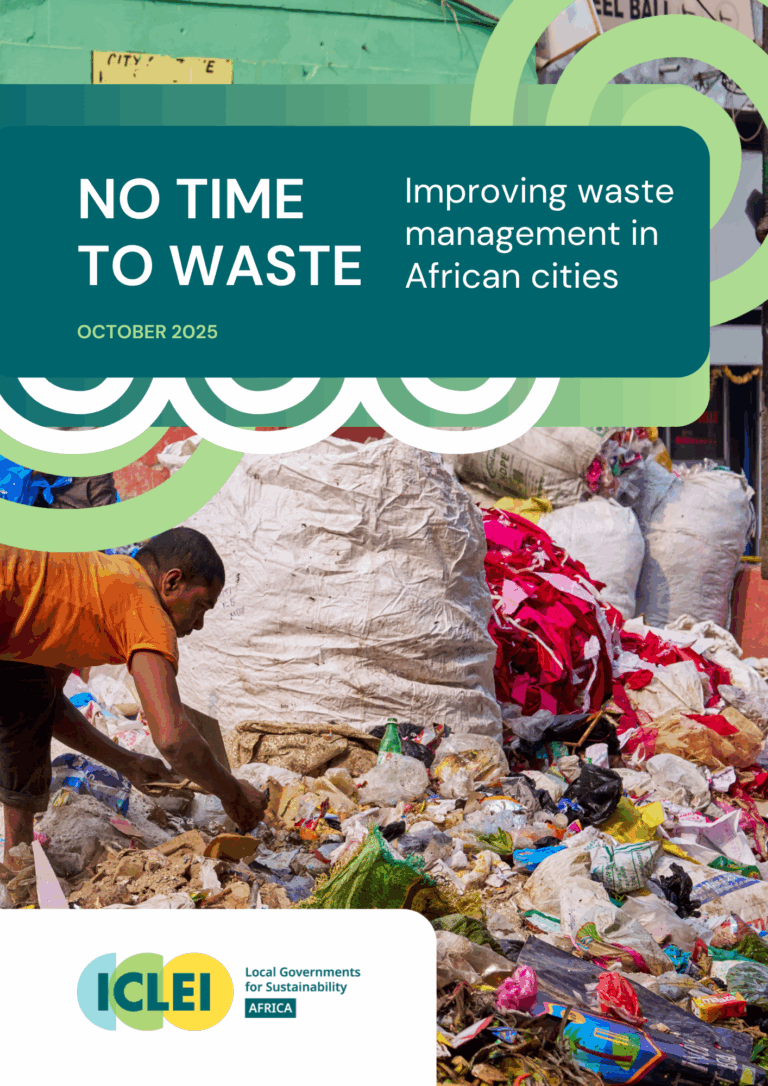
No Time to Waste – Improving Waste Management in African Cities
Africa’s waste crisis is accelerating as urban populations grow and consumption patterns change, yet investment in waste systems remains fragmented and misaligned with local realities. The No Time to Waste report speaks directly to governments, development partners, financiers, and city practitioners, offering practical pathways to reshape how waste systems are planned, governed and funded.
It underscores the urgency of creating financing models that reflect Africa’s unique waste profiles, fiscal constraints, and governance contexts, and provides actionable guidance to support cleaner, healthier and more resilient African cities.
Readers will find:
Clear analysis of financing investment entry points across the waste value chain.
Guidance on cost-recovery instruments, regulatory reforms, and aggregation models that African governments and their partners can use to attract and manage investment.
Practical models for pooling finance and scaling smaller projects across cities and regions.
Examples of policy and coordination mechanisms that enable small- and medium-sized cities to participate in regional and/ or national financing programmes.
Insight into how financing models should reflect local waste conditions — such as composition, density, and calorific value — to ensure investments fit real market needs.
Clarity on how investor risk can be reduced in areas with limited institutional capacity, such as weak oversight, a shortage of skilled waste professionals, or the absence of cost-reflective waste tariffs and tipping fees.
By linking local realities with financial and governance solutions, this report offers a roadmap for decision makers seeking to transform Africa’s waste challenge into an opportunity for green jobs, cleaner environments, and inclusive urban growth.
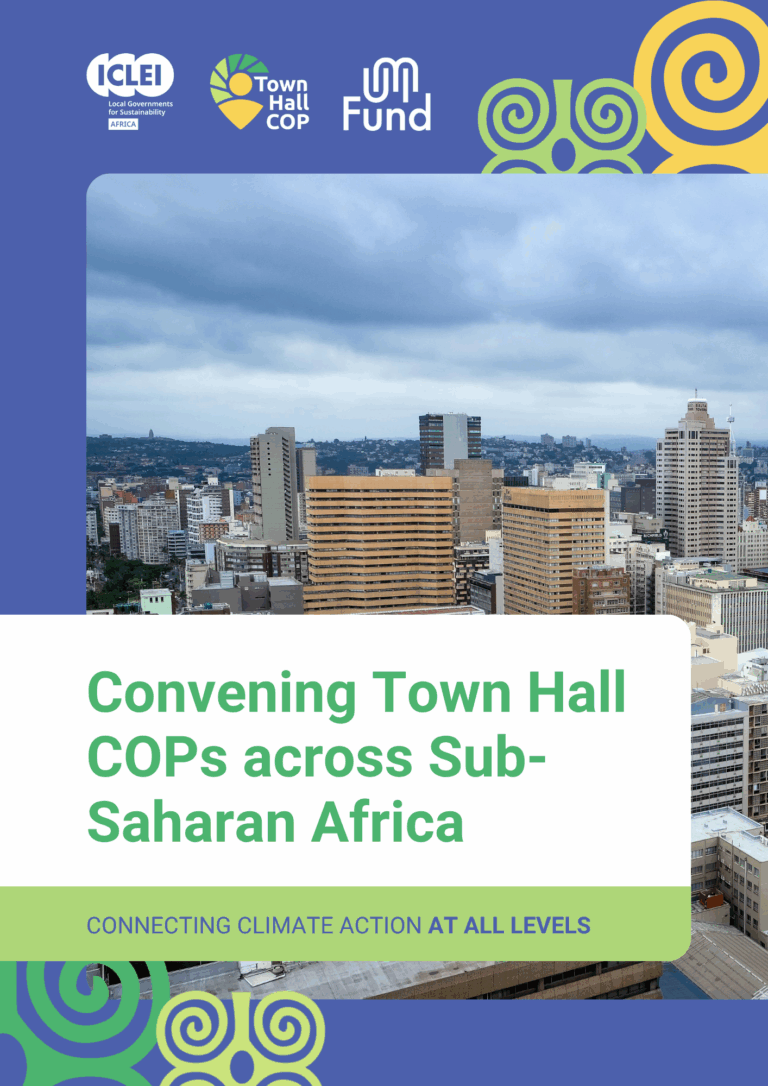
Convening Town Hall COPs across Sub-Saharan Africa
The report captures the outcomes of the Town Hall COPs hosted in 2025 by numerous Sub-Saharan African cities. Town Hall COPs are a pioneering initiative inspired by the structure of the UN Climate Change Conferences. Town Hall COPs provide locally driven platforms for co-creating solutions across all tiers of government and segments of society, to inform inclusive Nationally Determined Contributions (NDCs).
Readers will find the key insights from 18 Town Hall COPs convened across six Sub-Saharan African countries – the most of any region – which generated actionable lessons across three pillars of resilience:
Circular economy: African cities are tackling waste challenges head on to create cleaner environments.
Climate action and livelihoods: Cities are advancing renewable energy, nature-based, and sustainable mobility solutions that both cut emissions and create green jobs.
Youth and communities: Who are leading local transformation through education initiatives and civic engagement.
The report also highlights the importance of national endorsement of Town Hall COPs. In South Africa, this was received from the country’s Department of Forestry, Fisheries and the Environment (DFFE), leading to 9 Town Hall COPs in South Africa, and ensuring that these Town Hall COPs have a tangible influence on nationally led processes. The South Africa Town Hall COPs were led by the South African Local Governments Association (SALGA), in partnership with ICLEI Africa, and both organisations are working on a Roadmap to COP27, to take these Town Hall COPs to the next level, in the lead up to the COP to be hosted on African soil.
A set of two reports providing guidance for South African municipalities (with applicability to many Global South cities) on municipal-enabled renewable energy projects:
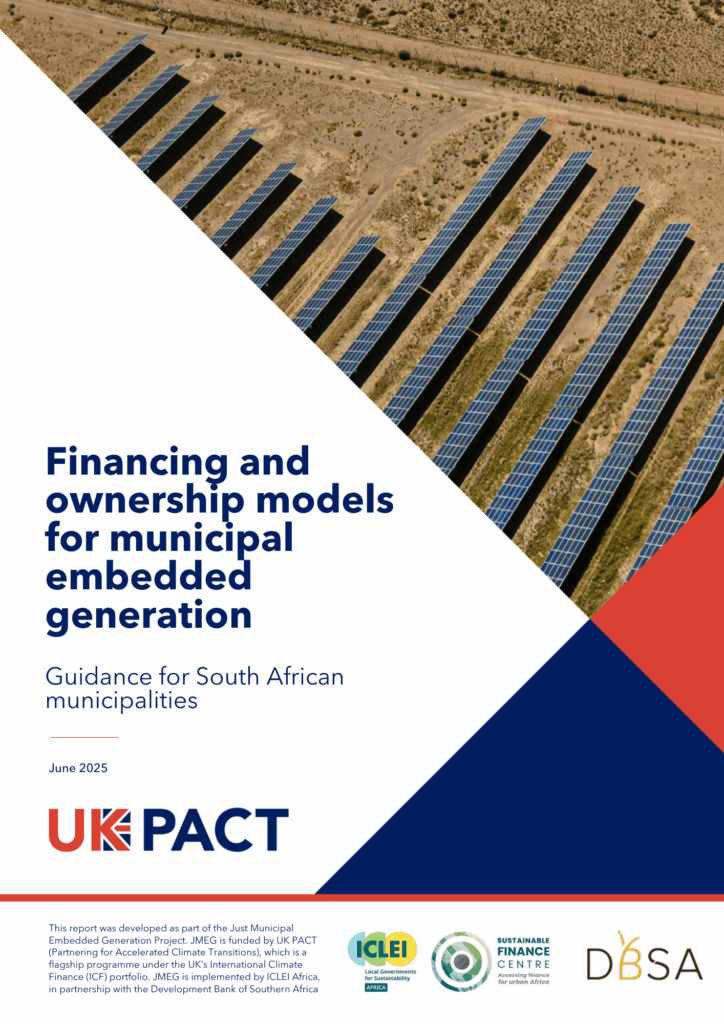
1. Financing and ownership models for municipal embedded generation
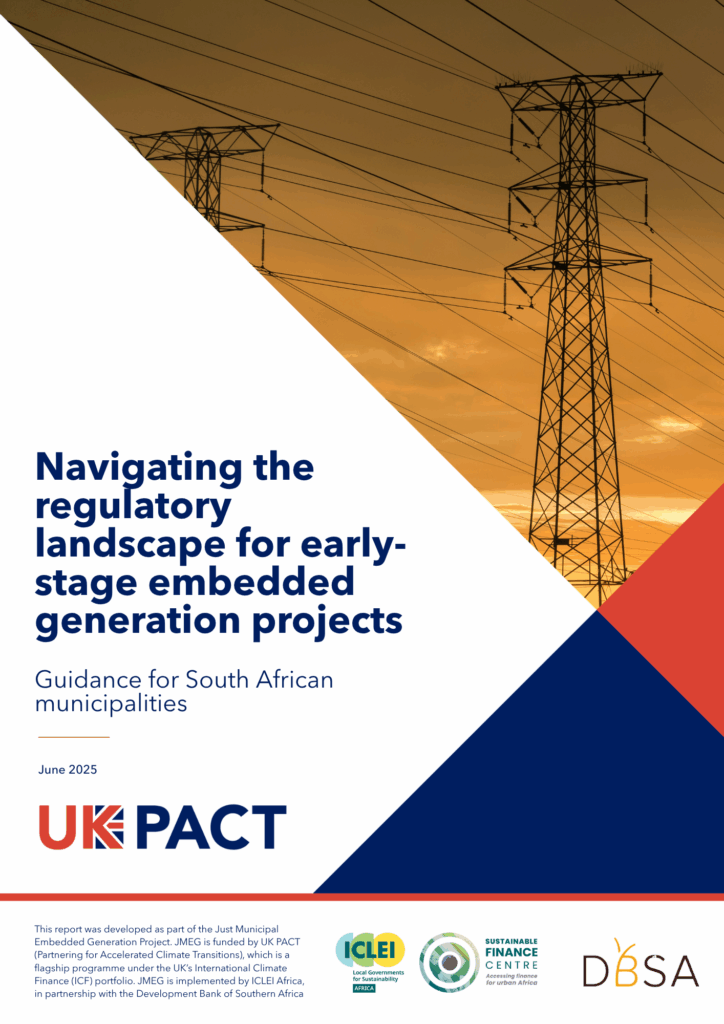
2. Navigating the regulatory landscape for early-stage embedded generation projects
ICLEI Africa works with African cities, towns and regions of all sizes to develop financing solutions tailored to their diverse realities and priorities. Intermediate cities are as important as primary cities in shaping the continent’s sustainable future. To this end, ICLEI Africa explores a range of options, including debt finance, public-private partnerships (PPPs), and project finance, meeting cities where they are and offering fit-for-purpose, impactful models that drive the energy transition. This includes providing pre-feasibility support to develop projects that can attract finance, but equally, if not more importantly, building the foundations needed to raise and utilise finance effectively.
The Just Municipal Embedded Generation (JMEG) project, funded by UK PACT and implemented by ICLEI Africa in partnership with the Development Bank of Southern Africa (DBSA), supports municipalities in South Africa to develop and structure municipal renewable energy projects. For many municipalities, this is new but critically important territory.
Together, these reports provide municipalities with:
Guidance on selecting the most suitable financing and ownership structure based on their financial, governance and social contexts.
Clarity on key regulatory levers and requirements for developing and managing municipal renewable energy projects.
By combining technical and regulatory guidance with practical and context-relevant financing strategies, these reports, complemented by support from ICLEI Africa and DBSA, are helping municipalities to move from talk to action. Action that unlocks clean energy investment for equitable, resilient energy systems across South Africa.
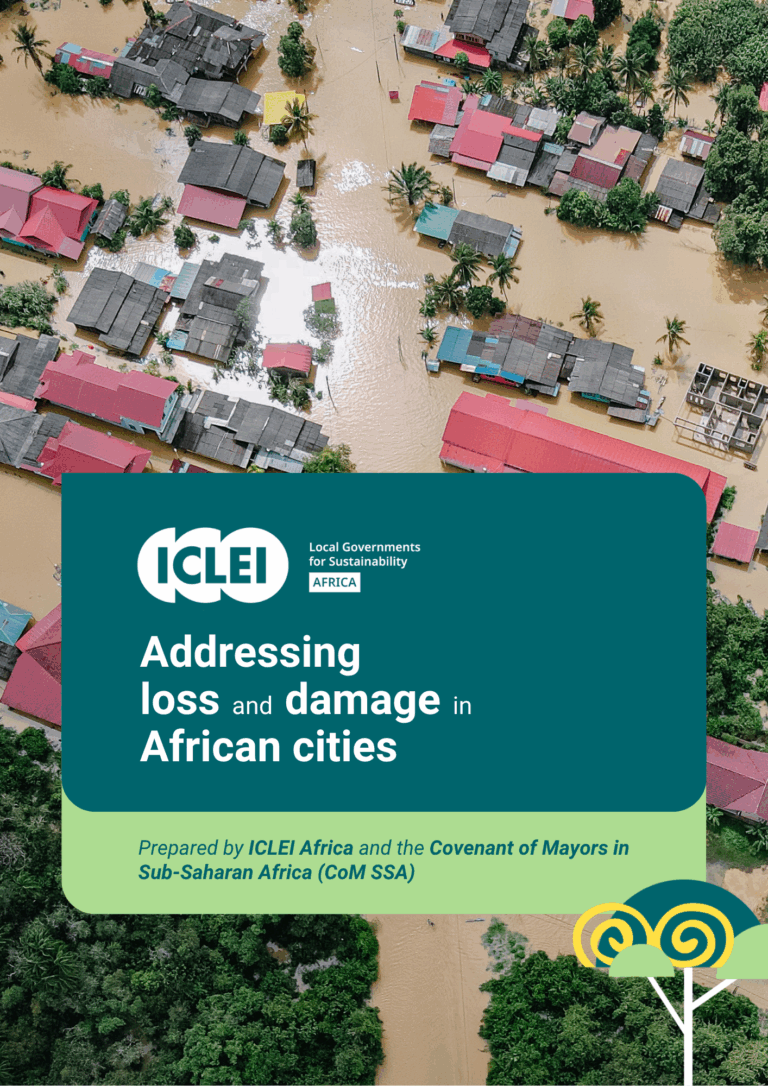
Addressing loss and damage in African cities
ICLEI Africa works with African cities, towns and regions of all sizes to strengthen resilience in the face of escalating climate impacts. While mitigation and adaptation remain essential, African cities are increasingly confronting unavoidable and irreversible climate losses, from damaged infrastructure and disrupted services to the loss of livelihoods, cultural heritage and ecosystems. Tackling these challenges at the local level is essential, particularly in informal settlements and rapidly growing urban areas where vulnerabilities are most acute.
In partnership with the Covenant of Mayors in Sub-Saharan Africa (CoM SSA), ICLEI Africa is supporting cities to build the evidence, capacity and systems needed to understand, document and respond to loss and damage. This includes developing practical methodologies and tools, integrating non-economic loss and damage into planning, strengthening attribution capabilities and preparing cities to access emerging loss and damage finance, including the new Loss and Damage Fund.
This report provides:
Clear, city-focused definitions and frameworks for loss and damage, including non-economic dimensions.
Guidance on strengthening local data systems, undertaking vulnerability and risk assessments, and applying attribution science.
Insights into emerging loss and damage finance mechanisms and how cities can position themselves to access them.
Recommendations for advancing multilevel governance, policy alignment, and city-to-city collaboration on loss and damage.
From readiness to action – Strengthening municipal capabilities for South Africa’s just energy transition and climate action through multilevel approaches | Cities & Regions Hub Action from People Living and Working in Informality to Build Resilience
As we look to Belém, we invite partners, funders, and local leaders to join us in advancing Africa’s urban climate agenda. Together, we can ensure that COP30 becomes not just a “COP of truth,” but a COP of transformation, where African priorities and perspectives make a significant contribution to global action for a just and climate-resilient future for all.
Share on social:
Stay in the loop
Sign up to our newsletter
Sharing impactful, innovative and inclusive action in African cities and regions

 Download the



 Follow a
  See our
  View our